The cosmic speed limit that refuses to budge.
Imagine riding a bike at 20 km/h and tossing a ball forward at 10 km/h. Anyone watching sees the ball move at 30 km/h. Speeds add. Life makes sense.
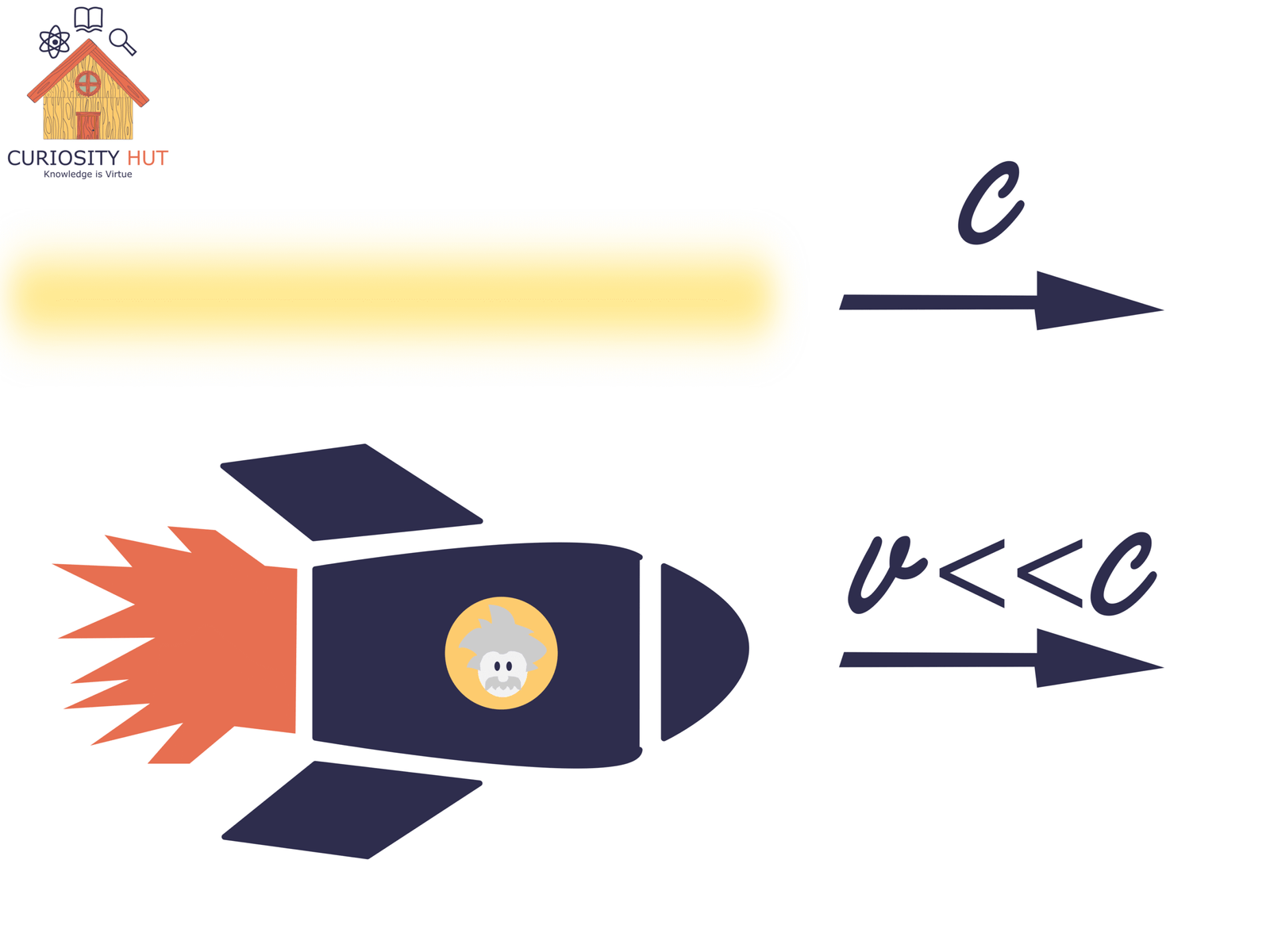
Now try the same thing with a flashlight. You’re moving. The light is moving. Yet the beam races away at the same speed it always does. No bonus 20 km/h. No stacking. Nature keeps the number fixed.
This stubborn behavior hints at a rule deeper than common sense. It’s the rule that sent young Einstein chasing a beam of light—and realizing the universe would break before he ever caught up.
Maxwell’s Speed Limit
James Clerk Maxwell wasn’t trying to set a cosmic law. He wanted to unify electricity and magnetism into one tidy system. But when he solved his equations, something extraordinary appeared: they predicted waves that always travel at a single speed. Not “usually.” Not “unless the source is moving.” Always.
I can’t show the math here, but Maxwell’s four equations—famous today—explain all classical electromagnetism. They show that light is an electromagnetic wave, and as such, it must travel at a fixed speed, denoted c. Always c. Never faster, never slower.
The speed comes straight from the constants of nature:
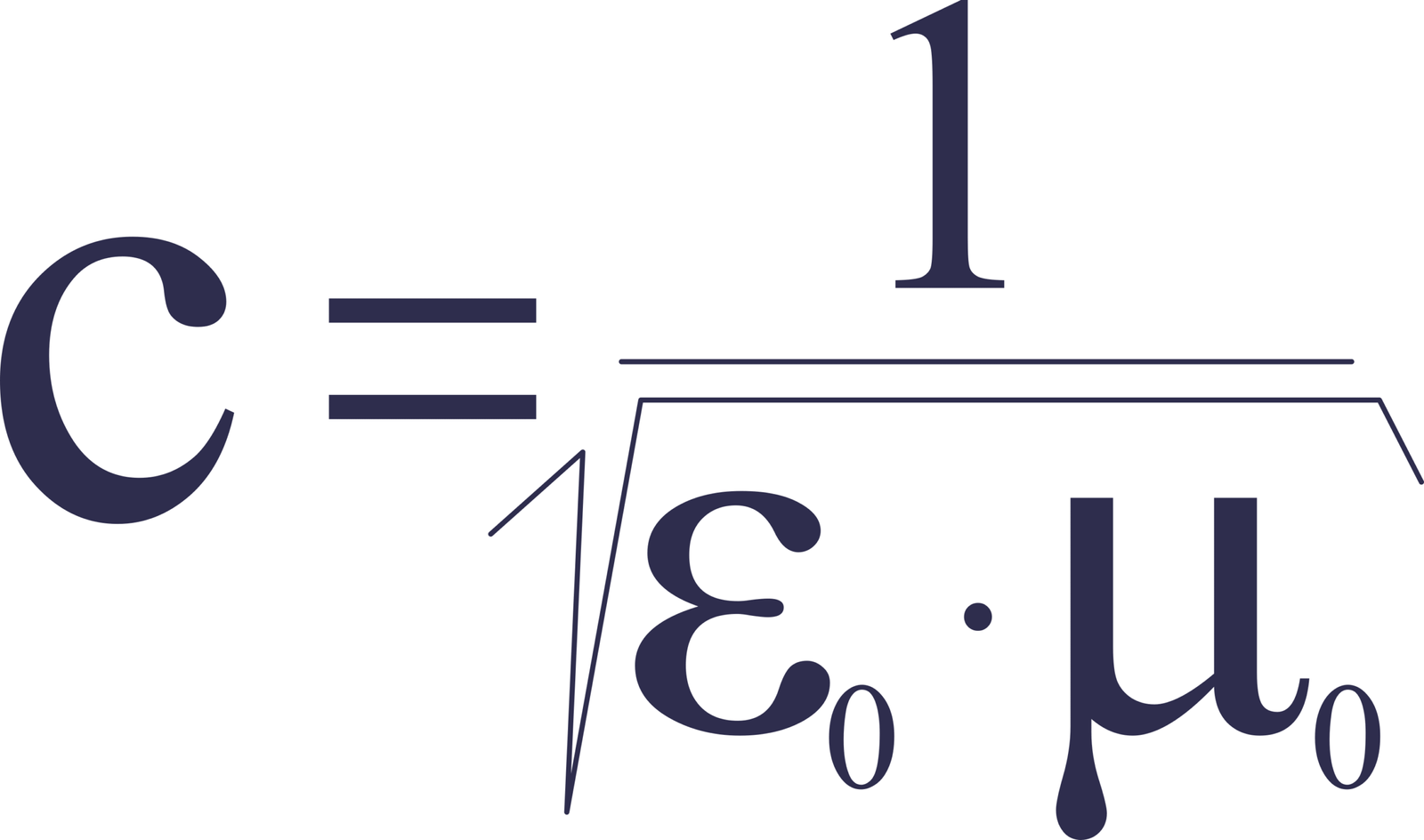
μ (pronounced me) is the magnetic permeability of a material. The magnetic permeability is the proportionality between the induced field and the applied magnetic field strength. Think about moving a metal object through a thin piece of wood. The wood permits a certain amount of the magnetic field through.
ε (epsilon) is the electric permittivity. Instead of magnets, it’s charged plates. It’s how much of the electric field the material allows through.
It’s as if the universe built a racetrack and locked the speed limit into the pavement. Push the flashlight. Sprint with it. The track doesn’t care. Light keeps its pace.
Subscribe to my Free Newsletter
Sign up for blog updates, science stories, riddles, and occasional musings. No algorithms—just me, writing to you.
Einstein Spots the Contradiction
If light’s speed never changes, our everyday intuition fails. Bikes, cars, baseballs—all obey additive speeds. Light refuses.
Einstein imagined chasing a beam of light. If he could match its speed, the wave should freeze beside him. Maxwell’s equations said it could never happen. The beam always races ahead.
This led Einstein to a radical choice: keep Maxwell’s constant speed of light and let everything else flex. He was not thinking about “special relativity” as we call it today; he was focused on the behavior of electromagnetism in moving frames. His 1905 paper, On the Electrodynamics of Moving Bodies, explicitly tackled Maxwell’s theory. It wasn’t a general treatise on time and space—it was about reconciling electromagnetic theory with the laws of motion.
Fun historical note: the editor who accepted and published Einstein’s paper was none other than Max Planck. The same Max Planck whose quantum work would eventually open another revolution in physics.
Breaking Newton
Einstein’s insight shattered Newtonian mechanics. For centuries, physics assumed absolute space and absolute time, and that velocities simply added. Light refused to play by those rules. To keep Maxwell’s speed consistent, the old framework had to bend. Time could no longer be a universal metronome. Space could no longer be a rigid container. Newton’s neat universe cracked open, replaced by a flexible, four-dimensional space-time.
Time Slows Down When You Move
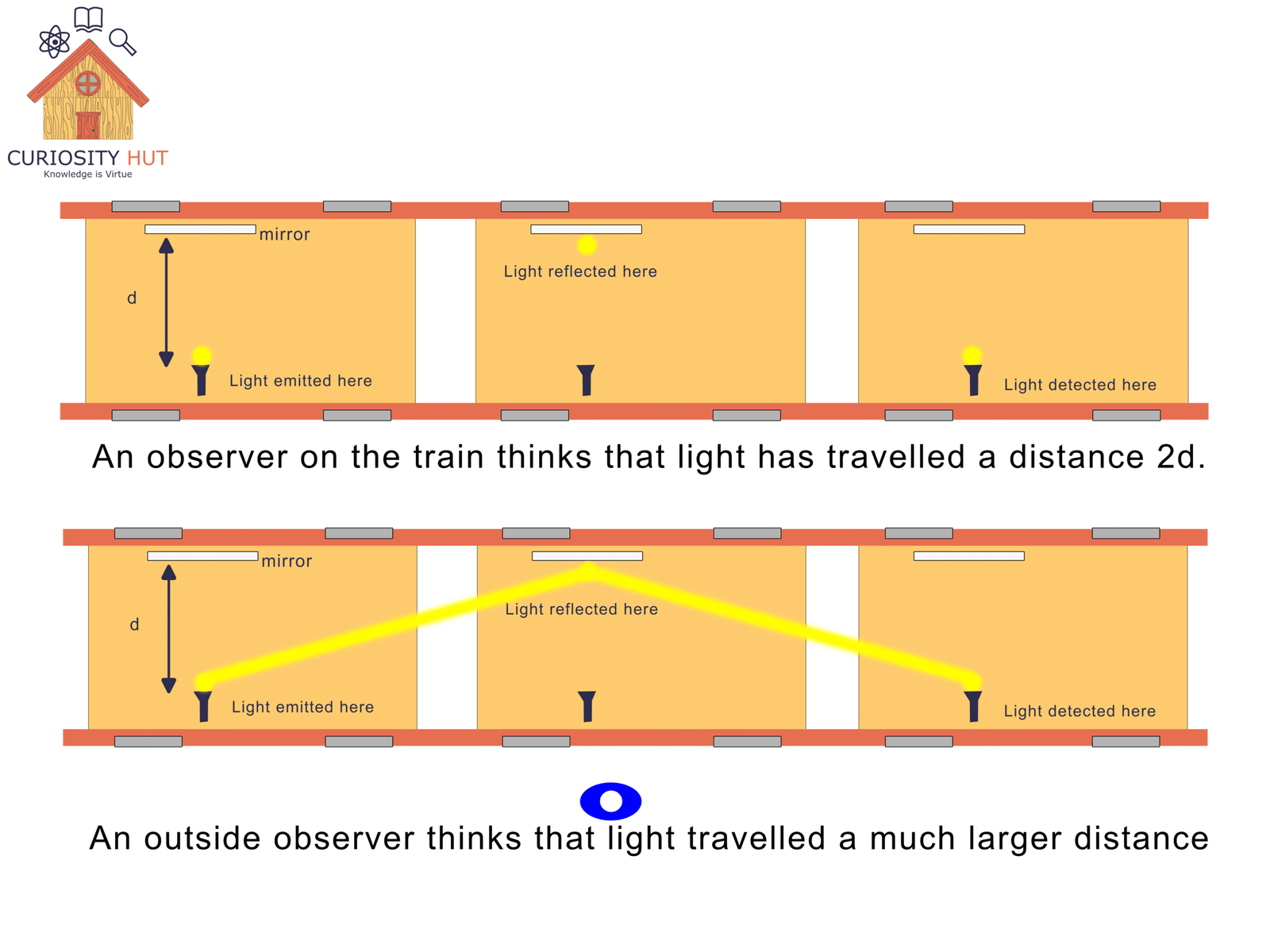
The simplest illustration is the “light clock”: a photon bouncing between two mirrors. For someone on the train, the photon moves straight up and down. For an outside observer, the system is moving, so the photon traces a diagonal path—a longer distance. Both must measure the same speed. The only way the math agrees is if time itself stretches.
This is time dilation. We see it in muons, particles born high in the atmosphere that decay in microseconds. At rest, they shouldn’t reach the ground. Yet moving near light speed, their internal clocks run slow, and more survive the trip.
Time dilation doesn’t let us cheat aging. At 90% of light speed, your body would age more slowly compared to someone standing still—but everything in your life slows. Reading, thinking, speaking: all stretches equally. To you, nothing feels different. Time bends to keep the universe consistent.
Learn more about space with BOOKS!
Space Compresses as You Speed Up

Time stretches; space must bend. Distances along the direction of motion shrink—length contraction. A spaceship moving near light speed looks almost paper‑thin from the outside, though inside it feels normal.
Time dilation and length contraction work together to lock in light’s speed. Space flexes just enough to enforce the cosmic speed limit.
Energy Turns Into Inertia
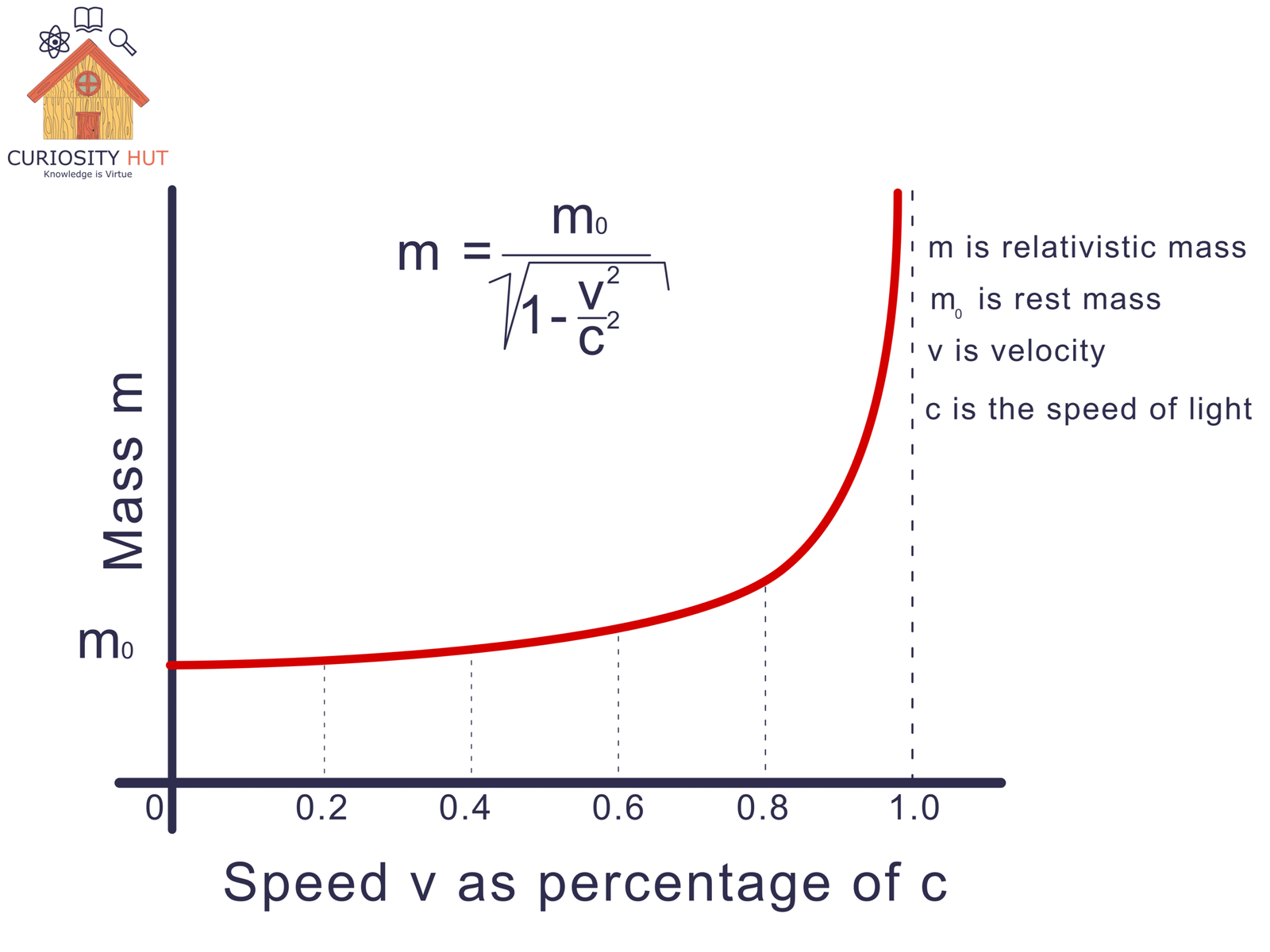
Time slows. Space compresses. But energy behaves strangely too. Adding energy to a fast-moving object doesn’t increase speed efficiently—it increases resistance.
Think of dragging a sled across smooth snow. Speed up, and snow piles form a ridge ahead. More effort fights the ridge than pushes forward. Near light speed, the ridge is space-time itself. Energy feeds distortions, not motion. Inertia grows, and the final barrier looms.
The Energy Wall: Light Speed Is Out of Reach
Approach light speed and everything combines: time dilation, length contraction, rising inertia. Energy poured in stretches time and compresses space, not speed. To reach light speed, you’d need infinite energy. Impossible.
Analogy: running on a treadmill that accelerates as you run. The faster you go, the harder it pushes back. Near light speed, it has infinite power. Even the fastest particles in accelerators get close but never cross the line. The universe simply will not allow it.
Anything Without Mass Travels at c
The speed limit isn’t just about light. Any particle with no mass and that doesn’t require a medium to propagate must travel at c. This includes photons, gluons (in theory), and—as we recently discussed in “What is the Speed of Gravity?”—gravitational waves. The universe enforces a strict rule: nothing without mass can exceed or fall short of this speed.
Why Nothing Can Go Faster Than Light
Exceeding light speed would break physics. Maxwell’s equations would fail. Space and time would tear. Cause and effect could reverse. Reality itself would unravel. Faster-than-light motion isn’t a challenge—it’s a contradiction. Light’s speed isn’t a barrier to overcome; it’s the scaffolding of the universe.
Einstein’s childhood thought experiment—chasing light—remains the perfect way to picture it. We can approach it, marvel at it, but never surpass it. Light is the ultimate law.
Living in a Light-Speed Universe
The speed of light isn’t just a number. It shapes time, stretches space, and resists every joule of energy we throw at it. We can’t beat it. We can only explore how the universe bends around it. Particles, planets, even time itself obey it. Nature doesn’t have to match our intuition—only its own rules. And those rules, strange and beautiful, make the universe possible.
From Maxwell’s unification of electricity and magnetism to Einstein’s daring leap that broke Newton, the cosmic speed limit defines everything we know. Light is not just fast. It is the law.
Subscribe to my Free Newsletter
Sign up for blog updates, science stories, riddles, and occasional musings. No algorithms—just me, writing to you.